

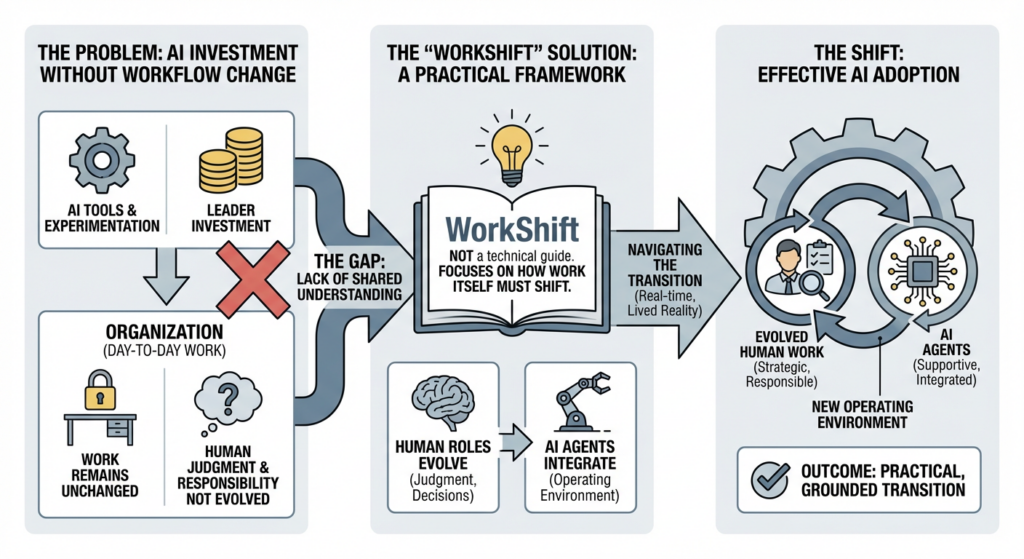
Most organizations are no longer asking whether AI will affect their business. That question has already been answered. The real uncertainty now is quieter and more difficult to resolve. It lives inside day-to-day work. Leaders are watching teams experiment with AI tools while core processes remain unchanged. Output improves in some places and degrades in others. Enthusiasm rises briefly, then fades. What emerges is not transformation, but fragmentation.
WorkShift exists to address that gap. It is not a framework for deploying AI tools. WorkShift is a guide for reshaping how work itself is approached in an environment where AI agents are already present. It starts from a simple observation. Most AI initiatives fail not because the technology is immature, but because the work around it has never been redesigned.
This is not a technical problem. It is a professional one.
The Origins of WorkShift
WorkShift began as a book, not a product concept. Written by John Arnott, CEO of C1M.ai, the WorkShift book was developed in response to a pattern he was seeing repeatedly inside organizations attempting to adopt AI. Leaders were investing in tools and experimentation, yet day-to-day work remained largely unchanged. Teams were being asked to “use AI” without a shared understanding of how human judgment, decision-making, and responsibility should evolve alongside it.
Rather than offering another guide to AI features or prompt techniques, the book approached the problem from a different angle. It focused on how work itself must shift when AI agents become part of the operating environment. WorkShift was designed as a practical framework for professionals navigating that transition in real time, grounded in lived organizational reality rather than theory.
Why AI Feels Disruptive Even When It Works
AI has an unusual effect on organizations. It makes inefficiencies more visible without automatically resolving them. When an AI agent can generate a draft in seconds, the hidden delays in review, approval, and decision-making become obvious. If research is accelerated, unclear strategy surfaces faster. When automation handles routine tasks, unresolved questions about ownership and judgment move to the foreground.
Many teams respond by trying to optimize the tool. They look for better prompts, more training sessions, or additional platforms. What they are actually experiencing is a mismatch between modern capability and an outdated work structure. AI exposes the limits of existing operating models.
WorkShift does not attempt to smooth over that discomfort. It treats it as a signal.
What WorkShift Actually Is
WorkShift is a structured, time-bound guide that helps professionals reorient how they think about work in the presence of AI agents. It is designed as a daily practice, not a reference manual. Each day introduces a single concept that reflects a real condition of modern knowledge work. The emphasis is not on mastery of tools, but on clarity of intent, judgment, and collaboration.
The format matters. WorkShift unfolds gradually because meaningful change rarely happens all at once. Professionals are asked to notice how they approach problems, how they delegate thinking, and where they unconsciously resist new ways of working. The progression is deliberate. Each concept builds on the last, reinforcing a shift in posture rather than imposing a new system.
What emerges over time is not technical fluency, but operational confidence.
From Task Completion to Intentional Collaboration
One of the central ideas in WorkShift is that AI should not be treated as a task executor. When professionals ask AI to complete an entire piece of work in one step, they often feel disappointed by the results. The output is usually generic, misaligned, or difficult to integrate into real decisions. This leads to mistrust, which slows adoption.
WorkShift reframes the relationship. AI is positioned as a collaborator that works best when the human partner provides direction, context, and feedback. This requires a change in habit. Professionals must slow down briefly at the beginning of a task to clarify what they are actually trying to accomplish. That clarity improves not only AI output, but human thinking as well.
The benefit is subtle but significant. Work begins to feel less reactive. Decisions are made with more intention. AI becomes a tool that supports judgment rather than replacing it.
Preserving Human Authority in an Automated Environment
A common fear surrounding AI is the loss of professional authority. When machines generate content, analyze data, or propose recommendations, people begin to question where their own value resides. This anxiety is rarely addressed directly, which allows it to shape behavior in unproductive ways.
WorkShift confronts this issue without reassurance or exaggeration. It draws a clear boundary between what AI can do and what remains fundamentally human. AI excels at processing information, recognizing patterns, and producing drafts. It does not understand organizational nuance, emotional context, or the consequences of decisions within lived systems.
By reinforcing this distinction, WorkShift restores a sense of agency. Professionals learn to override AI when necessary, not defensively but confidently. They understand when to accept suggestions and when to redirect them. Authority is not surrendered. It is exercised more deliberately.
Why Iteration Matters More Than Precision
Many professionals bring perfectionist habits into their interactions with AI. They try to craft flawless instructions and expect complete solutions on the first attempt. When this fails, frustration follows. WorkShift challenges this expectation by emphasizing iteration over precision.
The shift is practical. Instead of attempting to solve an entire problem in one request, professionals learn to break work into stages. AI contributes at each stage, while the human partner evaluates and refines. This mirrors how experienced teams already work together, but without the time constraints that usually slow progress.
The result is higher quality work produced more efficiently. More importantly, professionals regain a sense of control over the process.
Attention as a Finite Resource
WorkShift treats attention as a strategic asset. AI can either fragment it or protect it. When professionals chase every possibility AI generates, they lose focus. When AI absorbs routine cognitive labor, attention is freed for deeper thinking.
This distinction matters because burnout is not caused by volume alone. It is caused by constant context switching and unresolved cognitive load. WorkShift helps professionals recognize where their attention is being spent and where it should be invested instead.
Over time, this leads to workdays that feel more coherent. Fewer tasks compete for priority. Decisions are made with less friction. AI becomes a stabilizing force rather than a distraction.
Organizational Impact Beyond Individual Productivity
Although WorkShift is designed as an individual practice, its effects extend well beyond personal efficiency. When teams share a common understanding of how AI fits into work, coordination improves. Expectations align. Review cycles shorten because the intent behind the work is clearer from the beginning.
For leaders, this creates visibility. Instead of wondering whether AI is helping or hurting performance, they can observe how it is being used within redesigned workflows. This makes it possible to scale success rather than chase isolated wins.
WorkShift becomes a cultural signal. It communicates that AI adoption is not about speed or novelty, but about professionalism.
Why This Matters Now
The next phase of AI adoption will not be defined by tools. It will be defined by whether organizations can integrate these capabilities into real work without creating instability. Those that succeed will not be the ones with the most advanced platforms, but the ones that redesign how decisions are made, how work is structured, and how responsibility is shared.
WorkShift offers a path through that transition. It does not promise transformation through automation. Instead it offers something more durable. And, it helps professionals adapt their thinking to a changed environment while preserving what makes their work valuable.
That is the shift that matters.
Moving From Experimentation to Maturity
Most organizations are already experimenting with AI. What they lack is a coherent way to move from experimentation to maturity. WorkShift fills that gap by focusing on the human side of the equation.
It does not ask professionals to work harder or faster. It asks them to work more consciously. In doing so, it creates the conditions where AI can deliver real value without distorting the work it touches.
For leaders navigating this transition, WorkShift is not a playbook. It is a reset. It invites a reconsideration of how work happens and who is responsible for shaping it.
That invitation is timely. The tools are already here. The question is whether the work is ready for them.
Where WorkShift Fits in AI Workforce Architecture
WorkShift is not a standalone philosophy. It is a foundational layer within a broader discipline that C1M calls AI Workforce Architecture. Before organizations can automate, scale, or deploy agentic systems responsibly, they must first understand how work actually happens. They must surface hidden effort, clarify decision ownership, and redesign workflows so humans and AI can operate together without friction.
That discovery and redesign process is formalized through the CARTA methodology: Capture how work truly operates, Analyze where value and drag exist, Architect intentional human and AI collaboration, and Guide adoption through measurable execution. WorkShift prepares individuals and teams for this transition by reshaping mindset and daily behavior before systems are introduced at scale.
If your organization is experimenting with AI but struggling to translate potential into durable performance, the issue is rarely the tools. It is the absence of workforce architecture.
CARTA exists to solve that problem.
If you are ready to move beyond experimentation and design AI-enabled work that actually holds up in practice, C1M can help you take the next step.