
AI Agents, Hardware, and Funding: How New Moves Reshape Enterprise Workflows
Across the AI landscape, a quiet but powerful shift is unfolding as agents, infrastructure, and capital converge to redefine how work gets done. For leaders thinking about the future of work, the latest moves from Manus, Meet-Ting, Meta, NVIDIA, and Thinking Machines Lab reveal where AI is heading next: autonomous agents, streamlined coordination, scalable hardware, and heavily funded platforms built for ambitious use cases. In this breakdown, we will explore what each development means for your organization and how you can position your teams, processes, and technology stack to harness these changes instead of reacting to them.
Understanding the Emerging AI Enterprise Stack
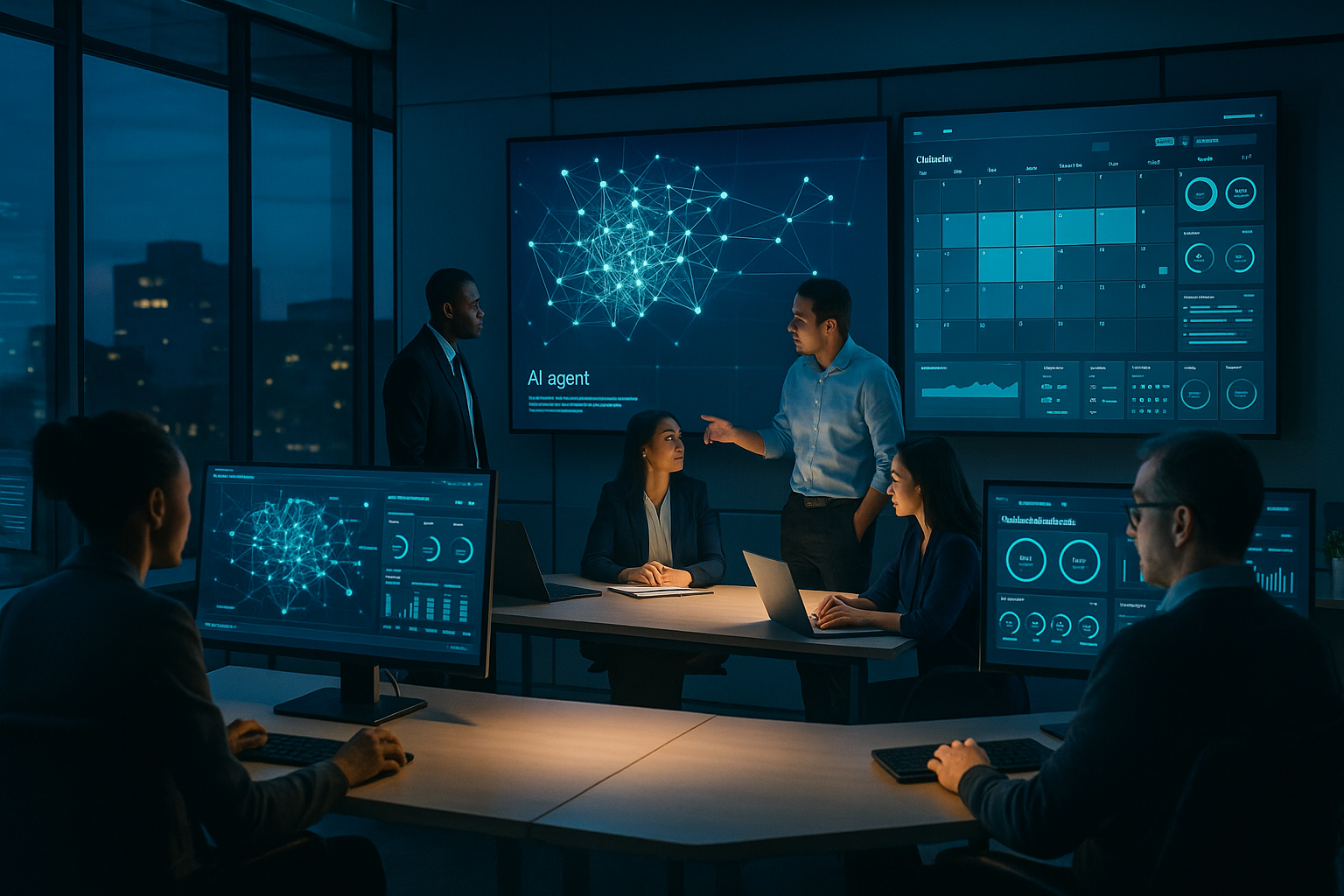
To make sense of these news stories, it helps to look at them as building blocks in a modern AI enterprise stack. At the application layer, AI agents like Manus take on complex tasks, such as writing and deploying code without constant human input. Workflow tools like Meet-Ting’s AI scheduling assistant streamline coordination, reducing the back-and-forth that slows teams down.
At the platform and ecosystem level, Meta’s acquisition of Moltbook points toward a world where AI agents collaborate inside dedicated environments, sharing context and capabilities. Beneath that, NVIDIA’s teased next-generation chip signals faster, more efficient AI hardware designed to power demanding workloads. Finally, Thinking Machines Lab’s multibillion-dollar funding round reflects the capital flowing into AI systems and platforms that aim to tie these layers together for real business impact.
5 Major AI Developments Every Business Leader Should Watch
1. Manus: Autonomous AI Agent for Code Deployment
Manus has demonstrated an AI agent capable of autonomously writing and deploying code, marking a meaningful advance in AI autonomy. From a business standpoint, this represents a new frontier in software development and operations. An AI agent that can move from code generation to deployment introduces the possibility of round-the-clock delivery pipelines, faster iteration cycles, and reduced manual intervention in routine updates. For technology-driven organizations, this kind of autonomous code deployment could shorten release timelines, support rapid experimentation, and help teams focus human effort on product strategy, security reviews, and complex system design. The core shift is that AI agents are beginning to handle end-to-end workflows, not just isolated tasks, which sets the stage for deeper automation across engineering and product teams.
2. Meet-Ting: AI-Powered Scheduling Assistant for Email Workflows
Meet-Ting, a London-based startup, has launched an AI-powered scheduling assistant focused on arranging meetings via email. While scheduling might seem simple on the surface, it consumes substantial time and attention across organizations. Meet-Ting’s assistant aims to streamline that friction by interpreting email threads, proposing meeting times, and coordinating confirmations on behalf of users. For businesses, this can translate into fewer delays, smoother internal and external collaboration, and more uninterrupted deep work for high-value contributors. By embedding AI directly into a common communication channel like email, Meet-Ting shows how narrow, targeted AI tools can quietly transform everyday workflows. It offers a practical example of workflow automation where measurable gains show up in calendar utilization, response speed, and reduced context-switching for teams.
3. Meta: Strategic Acquisition of Moltbook for AI Agent Collaboration
Meta has acquired Moltbook, described as a social network for AI agents, with the goal of enhancing its AI capabilities and fostering collaboration between agents. This move indicates that Meta is investing in environments where multiple AI agents can interact, share information, and coordinate behavior. For enterprises, such a platform concept hints at future scenarios where a company’s analytics agent, support agent, and operations agent can work together within a shared context rather than operating in isolation. The acquisition underscores a shift toward orchestrated agent ecosystems, where AI agents act as interconnected digital teammates. For organizations exploring AI, Meta’s move points to the importance of designing architectures that anticipate multi-agent collaboration, governance, and monitoring, especially as AI becomes embedded in customer experiences, internal productivity tools, and operational systems.
4. NVIDIA: Next-Generation Chip to Power Intensive AI Workloads
NVIDIA CEO Jensen Huang has teased a forthcoming chip described as “a chip that will surprise the world,” expected to be revealed at the next GTC conference. While the technical details remain under wraps in the announcement, the signal for enterprises is clear: AI hardware continues to accelerate. New chips from NVIDIA typically drive higher performance, better efficiency, or new capabilities for training and running advanced AI models. For businesses planning multi-year AI strategies, this kind of hardware evolution matters for total cost of ownership, deployment options, and the feasibility of more sophisticated AI use cases. As models and AI agents become more capable and more deeply integrated into workflows, the underlying infrastructure must keep pace. NVIDIA’s teased chip reminds leaders that hardware roadmaps should be part of any serious AI planning conversation.
5. Thinking Machines Lab: $2 Billion Funding to Advance AI Systems and Platforms
Thinking Machines Lab, an AI startup founded by Mira Murati, has raised a $2 billion funding round to advance its AI systems and platforms. This level of investment signals strong confidence from the market in the company’s vision and ambition. For enterprises, a heavily funded platform player can become a long-term partner, offering evolving capabilities and robust support for complex AI initiatives. The funding allows Thinking Machines Lab to accelerate research, scale infrastructure, and build out tools that help organizations adopt AI at depth and at scale. Whether you are exploring AI for data analysis, customer engagement, or workflow automation, the emergence of well-capitalized AI platforms broadens your options for partnership, integration, and innovation over the coming years.
Why These AI Shifts Matter for the Future of Work
Together, these five developments paint a picture of an AI ecosystem that is rapidly maturing along multiple dimensions. Manus shows how AI agents can take ownership of complex, end-to-end workflows like autonomous code deployment. Meet-Ting illustrates how focused tools can remove everyday friction, giving people more time for strategic work. Meta’s acquisition of Moltbook points toward collaborative AI environments where multiple agents coordinate activities, which aligns with the vision of AI as a network of digital teammates embedded across your organization.
NVIDIA’s upcoming chip emphasizes that none of this happens without powerful, efficient AI hardware capable of handling large-scale computation. Thinking Machines Lab’s substantial funding round demonstrates the level of capital flowing into platforms that aim to bring these capabilities together in usable, enterprise-ready ways. For business leaders, the combined message is that AI is shifting from isolated experiments to integrated systems that support entire business functions. The opportunity lies in thoughtfully mapping where agents, assistants, platforms, and hardware can reinforce your strategy, improve resilience, and create new value for customers and employees.
How Your Organization Can Respond Strategically
To capitalize on these trends, start by assessing where AI agents could safely accelerate existing workflows. For software and product teams, Manus-style autonomous code deployment suggests a future where AI handles repetitive build and deployment tasks under human supervision. You can pilot agents in controlled environments, using guardrails and monitoring to ensure quality while capturing speed and efficiency gains.
Next, look at everyday coordination pain points. A tool like Meet-Ting’s AI scheduling assistant provides a blueprint for automating narrow but high-frequency tasks that drain time from your teams. Mapping out email-driven processes, customer follow-ups, or recurring meeting patterns can reveal areas where similar AI-powered automation would deliver fast returns.
On the ecosystem side, Meta’s push toward agent collaboration signals that multi-agent systems may soon be central to enterprise AI strategies. You can prepare by defining how different AI services in your organization will share context, data, and responsibilities. Clear governance, security, and observability will matter as agents increasingly interact with each other and with critical business systems.
From an infrastructure perspective, NVIDIA’s forthcoming chip underlines the value of aligning your AI roadmap with hardware advances. Whether you rely on cloud providers or on-premise deployments, understanding performance and cost implications of new AI hardware helps you plan scalable initiatives. Finally, the scale of funding for Thinking Machines Lab invites leaders to evaluate emerging AI platforms alongside incumbent providers, balancing innovation potential with stability, integration options, and long-term partnership fit.
Conclusion: Turning AI Momentum into Measurable Business Value
The latest AI developments from Manus, Meet-Ting, Meta, NVIDIA, and Thinking Machines Lab show a coordinated movement toward more autonomous agents, streamlined workflows, powerful infrastructure, and well-funded platforms designed for ambitious transformation. For your organization, the path forward is to experiment with targeted use cases, build internal literacy around AI agents and hardware, and design architectures that can evolve as the ecosystem grows.
If you are ready to explore where AI can deliver the greatest impact across your operations, marketing, customer experience, or product development, we are here to help you navigate the options with clarity and confidence. Contact us to discuss practical ways to align these emerging AI trends with your business goals and to design a roadmap that turns innovation into measurable results.