

For most organizations, AI adoption has followed a familiar pattern. A tool is introduced. A pilot is launched. A few productivity wins are celebrated. And then complexity creeps back in.
What’s missing is not intelligence, funding, or intent. What’s missing is architecture.
The idea of an AI Agentic Workforce shifts the conversation away from isolated tools and toward a coordinated system of specialized AI agents designed to support real work across the organization. Instead of asking, “What can AI do?” the better question becomes, “How should work be structured when humans and AI collaborate intentionally?”
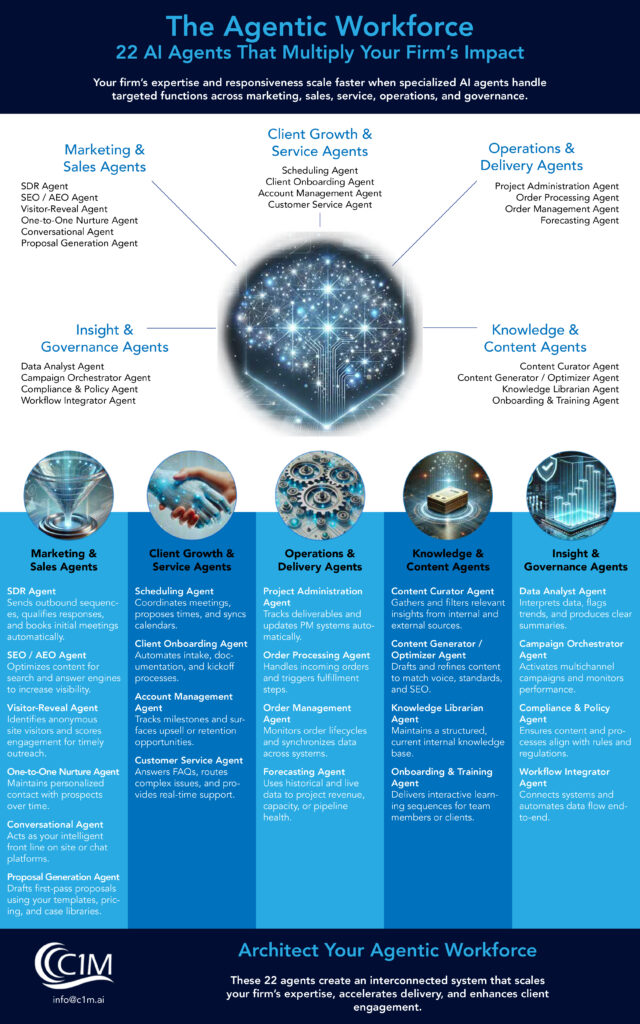
That question is what the AI Agentic Workforce infographic is designed to answer. (You can download the graphic here.)
From Tools to Systems
Most AI tools are introduced as individual capabilities: a chatbot here, a content generator there, an analytics assistant somewhere else. Each tool may be useful on its own, but without coordination, they add friction instead of removing it.
An agentic workforce reframes AI as a system of roles, not a collection of features.
Each agent has a clear function, a defined scope, a place in a broader workflow, and a relationship to both humans and other agents.
This mirrors how effective human teams already work. We do not ask one person to do everything. We design roles, responsibilities, handoffs, and accountability. The same logic applies to AI.
The infographic outlines 22 specialized AI agents across five functional domains: Marketing & Sales, Client Growth & Service, Operations & Delivery, Knowledge & Content, and Insight & Governance. Together, they form an interconnected workforce that scales execution without eroding judgment.
Marketing and Sales: Scaling Without Losing Signal
In the agentic model, marketing and sales agents are not generic “growth bots.” They are narrowly focused contributors.
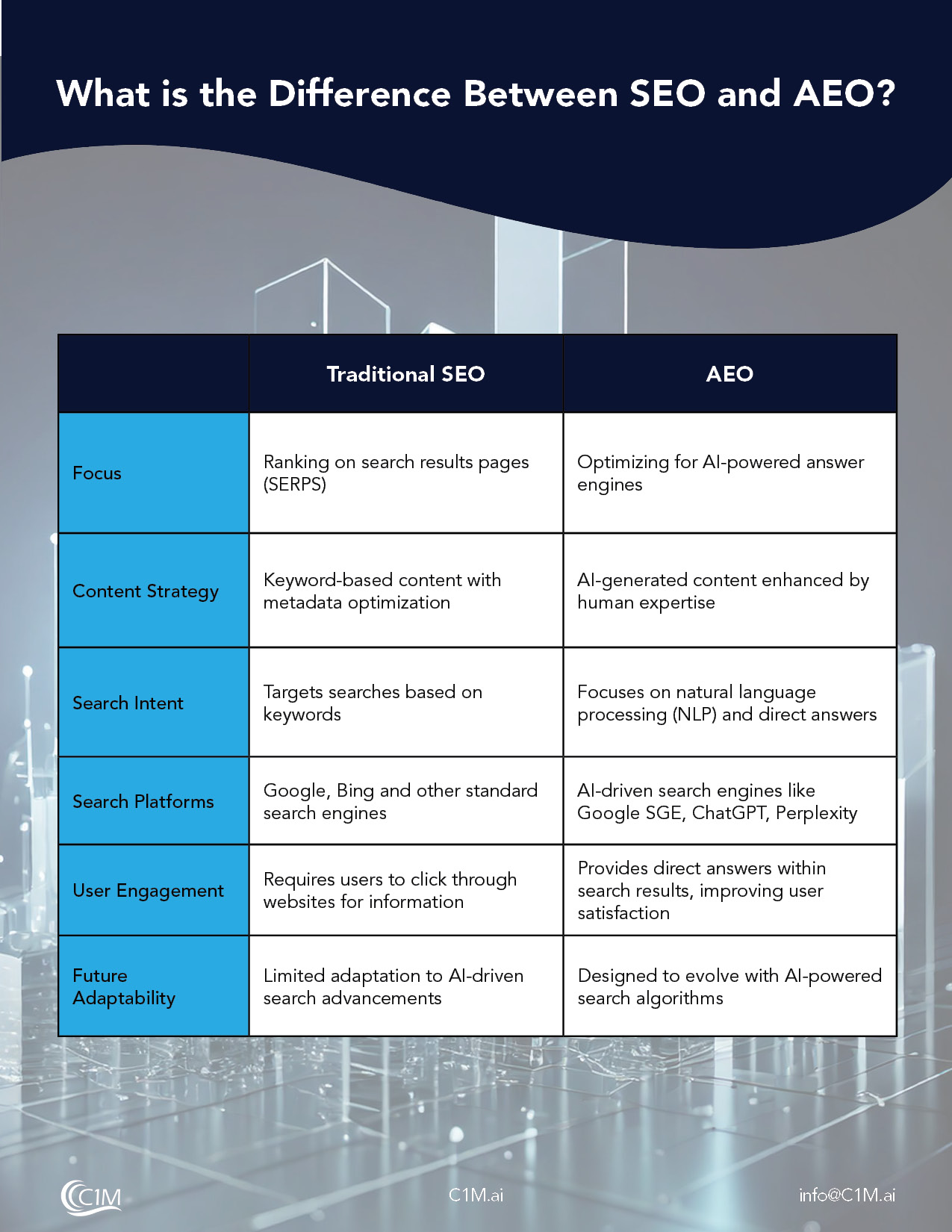
Agents like the SEO/AEO Agent, SDR Agent, Visitor-Reveal Agent, and Proposal Generation Agent handle targeted, repeatable tasks that often consume disproportionate human time. They draft, optimize, qualify, score, and prepare.
What they do not do is replace strategic thinking, relationship building, or final decision-making.
This distinction matters. As explored in WorkShift, AI works best when it amplifies clarity rather than substituting for it. The more intentional the role definition, the more valuable the output.
When these agents operate together, marketing and sales teams gain leverage without drowning in dashboards or automation noise.
Client Growth and Service: Continuity at Scale
Client relationships often suffer not from lack of effort, but from lack of continuity. Information gets lost. Context resets. Follow-ups slip.
Agents like the Client Onboarding Agent, Account Management Agent, Scheduling Agent, and Customer Service Agent are designed to preserve continuity across the client lifecycle.
They ensure that:
- Intake information is structured and reusable
- Milestones are tracked consistently
- Routine questions are answered quickly
- Human attention is reserved for moments that matter
This is not about depersonalization. It is about protecting human presence by removing unnecessary administrative drag.
As WorkShift notes, “AI handles routine processing so humans can focus on judgment, creativity, and relationships.” That principle is embedded directly into the architecture of these agents.
Operations and Delivery: Making Work Visible
Operations is where AI either quietly delivers value or quietly breaks trust.
Agents such as the Project Administration Agent, Order Management Agent, Forecasting Agent, and Workflow Integrator Agent focus on visibility and coordination. They surface status, synchronize systems, and reduce manual reconciliation.
Importantly, these agents are not decision-makers. They are sense-makers.
They provide timely, structured information so humans can act with confidence. When work becomes visible, organizations stop managing by assumption and start managing by reality.
This is where many AI initiatives fail. They automate without understanding the actual flow of work. An agentic approach starts with clarity, not automation.
Knowledge and Content: Turning Information into Infrastructure
Most organizations are information-rich and insight-poor.
The Content Curator Agent, Content Generator/Optimizer Agent, Knowledge Librarian Agent, and Onboarding & Training Agent address this imbalance by treating knowledge as infrastructure, not exhaust.
These agents capture institutional knowledge, keep content current and consistent, support onboarding and learning, and reduce dependence on tribal memory.
Rather than replacing expertise, they make expertise more accessible.
In WorkShift, one recurring theme is that AI becomes a mirror for organizational clarity. When knowledge is fragmented, AI output is generic. When knowledge is structured, AI becomes remarkably useful.
Insight and Governance: The Missing Layer
The most overlooked part of AI adoption is governance.
Agents like the Data Analyst Agent, Compliance & Policy Agent, Campaign Orchestrator Agent, and Workflow Integrator Agent ensure that AI systems operate within boundaries, standards, and strategic intent.
They help answer questions such as:
- Are we complying with internal and external rules?
- Are campaigns performing as expected?
- Are systems connected end-to-end?
- Are insights actionable or just interesting?
Without this layer, scale becomes risk.
With it, scale becomes sustainable.
Why This Matters Now
The AI Agentic Workforce is not a futuristic concept. It is a practical response to how work is already changing.
Organizations that treat AI as a set of tools will continue to struggle with fragmentation. Organizations that design AI as a workforce will gain leverage, clarity, and resilience.
The infographic is a starting point, not a prescription. In fact, this should be considered a living document as new Agents will be added as time goes one. It is meant to provoke better questions about how work should be structured in an AI-augmented organization.
And as WorkShift reminds us, the success of any AI system ultimately reflects the clarity, intention, and leadership behind it.
If you’re ready to integrate an agentic workforce into your business, we’re ready to show you how with a roadmap. Let’s discuss your Workflow Discovery.